Reconstitution
Dissolving lyophilized peptides into solution for laboratory work.
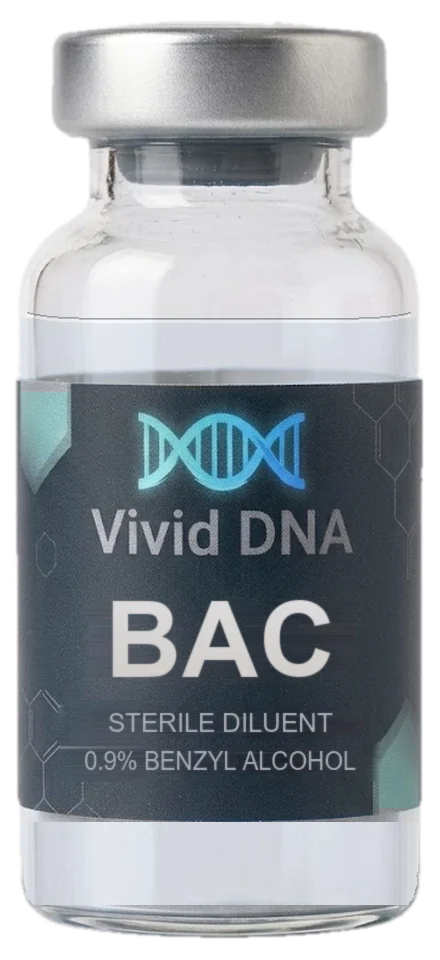
BAC water · sterile diluent · 0.9% benzyl alcohol
Sterile water with 0.9% benzyl alcohol, the standard diluent for reconstituting lyophilized research peptides in the lab.
For laboratory research use only. Not for human or veterinary use.
Bacteriostatic water is sterile water containing 0.9% benzyl alcohol. The benzyl alcohol is a preservative that inhibits bacterial growth, so a vial can be punctured and drawn from more than once, unlike single-use sterile water.
In the laboratory it is used to reconstitute lyophilized (freeze-dried) peptides into solution. Each 30ml multi-use vial is enough to reconstitute many research vials. It is a supply, not a research compound, so it does not count toward volume-pricing tiers.
How bacteriostatic water is used alongside lyophilized compounds.
Dissolving lyophilized peptides into solution for laboratory work.
Benzyl alcohol preservative allows repeated withdrawals from one vial.
Preparing working concentrations from reconstituted stock.
A standard companion to any lyophilized research compound.
| Product | Bacteriostatic Water |
|---|---|
| Also known as | BAC water · sterile diluent · 0.9% benzyl alcohol |
| Class | Sterile diluent (water with 0.9% benzyl alcohol) |
| Form | Sterile solution |
| Volume | 30ml |
| Storage | Room temperature, 68–77 °F. Discard 28 days after first puncture. |
| Documentation | Lot number supplied in writing with every order |
| Intended use | Laboratory research only. Not for human or veterinary use. |
It is used in the lab to reconstitute lyophilized peptides. The 0.9% benzyl alcohol keeps the vial usable for multiple withdrawals.
Sterile water has no preservative and is single use. Bacteriostatic water contains 0.9% benzyl alcohol, so it can be drawn from repeatedly.
Multi-dose vials are typically discarded 28 days after the first puncture. Store at room temperature, 68–77 °F.
Research use only. All Vivid DNA products are sold strictly for laboratory research. They are not drugs, foods, cosmetics or supplements, are not for human or veterinary use, and are not intended to diagnose, treat, cure or prevent any disease. Statements on this page describe published and preclinical research and have not been evaluated by the Food and Drug Administration.